The short answer
A ready-made CRM suits small teams with a standard sales process who need to start quickly. A custom CRM makes sense when your process does not fit the template, subscription costs keep rising, you need deep integration or full Arabic support, or you want to own the code and data.
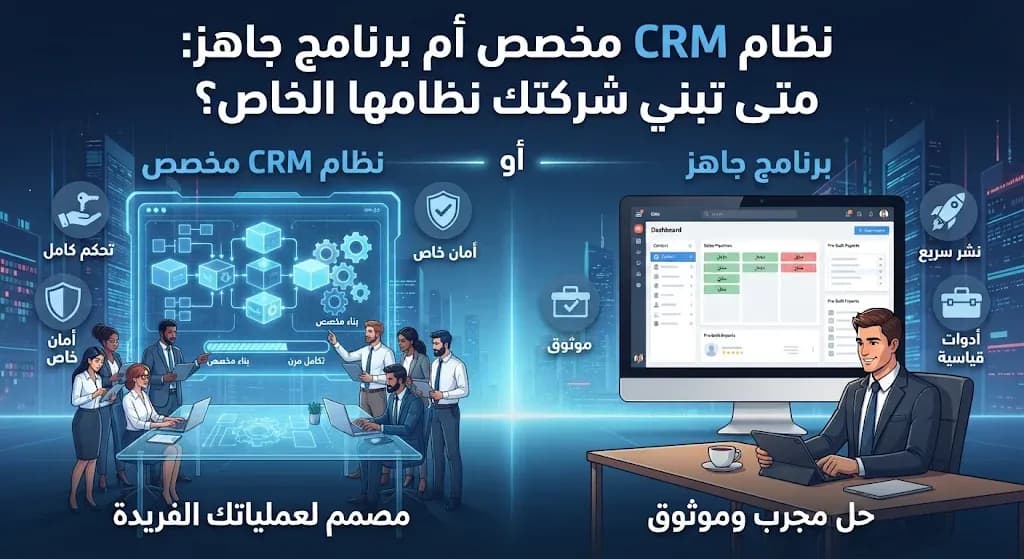
Sooner or later, every growing company in the UAE hits the same wall: customer details live in spreadsheets, WhatsApp chats and the heads of a few salespeople. The obvious fix is a CRM. The harder question is which kind. Should you subscribe to a well-known platform and adapt your team to it, or build a system shaped around the way your company already works? There is no single right answer, but there are clear signals that point one way or the other.
Two different starting points
A ready-made CRM is a subscription product used by thousands of companies. You get mature features on day one and pay per user, per month. You can configure fields, stages and reports, but only within the limits the vendor has set.
A custom CRM is software built for one company. Its screens, stages, permissions and reports follow your processes, and it connects to the tools you already rely on. When it is built under the right contract, the code and the data belong to you, so you are not tied to a vendor's pricing or roadmap.
When a ready-made system is the sensible choice
Off-the-shelf software is often the right first step. It usually fits when:
Your sales cycle is close to the classic pattern: lead, contact, quotation, deal.
The team is small, so the monthly cost per user stays modest.
You need something running within days, not months.
The integrations you need, such as email or a calendar, are available as standard add-ons.
Arabic is needed only for occasional messages, not for reports and the whole interface.
If most of these points describe you, start with a ready-made tool, learn what your team really uses, and revisit the decision when the business changes.
Signs your company has outgrown ready-made software
The case for a custom system grows when the software starts shaping the business, rather than the other way round. Watch for these signs:
Your process does not fit the template. Real-estate units moving through reservation and handover, clinics following up on patients, contracting projects with stages and site visits, or instalment-based sales rarely sit neatly in a generic pipeline.
Workarounds everywhere. The team keeps a side spreadsheet because the CRM cannot hold what they need.
Subscription costs climb faster than value. Each new user, module or premium tier adds to the bill, and the total over several years becomes significant.
Deep integration is required. You need the CRM to talk directly to your mobile app, website, payment gateway, WhatsApp channel or accounting software.
Arabic is a first-class need. Your customers and staff work in Arabic, and partial right-to-left support in reports or messages creates friction.
Control over data and access. You want fine-grained permissions, a record of who changed what, or a clear decision on where your data is hosted.
Side-by-side comparison
Factor | Ready-made CRM | Custom CRM |
|---|---|---|
Getting started | Fast, often within days | Needs a study, design and build phase |
Cost pattern | Low entry, recurring fees that grow with users and modules | Higher upfront investment, then maintenance as you need it |
Fit with your process | You adapt to the product | The product adapts to you |
Integrations | Limited to what the vendor supports | Built around your apps, site and tools |
Arabic support | Varies by product | Designed in from the start |
Ownership | You rent access; data export depends on the vendor | Code and data can be fully yours under the contract |
The core features any CRM must get right
Whichever route you choose, check that the system covers the basics well:
One complete record per customer, with history, notes and documents.
Clear sales stages, each with an owner and a next action.
Tracking of where each lead came from, so you know which ads and channels pay off.
Role-based permissions for sales, management and support staff.
Reports that management can read without exporting to Excel.
A usable mobile experience for teams who work in the field.
Reminders and alerts so follow-ups and stalled deals are not forgotten.
Building a custom system without unnecessary risk
Custom software fails when it tries to do everything at once. A safer path looks like this:
Map how work really happens today, including the spreadsheets and chat groups people rely on.
Pick the most painful stage and make it the core of the first version.
Design the screens first and review them with the people who will use them every day.
Plan the data migration from spreadsheets or the old system, and clean the data as you move it.
Train the team, launch, then grow in phases based on real usage.
Put ownership and support in writing: who owns the code and data, and what happens after launch. Our guide on code ownership after delivery explains what to check.
Questions to answer before you decide
What will each option cost over three years, including users you plan to add?
Can you export all of your data if you change systems later?
Is Arabic supported fully, including reports, messages and printed documents?
How will the CRM connect to your website, app and accounting?
Where is the data hosted, and who can access it?
Who fixes problems, and how quickly?
If you are weighing a similar decision for a customer-facing app, our comparison of ready-made and custom apps follows the same logic.
How MetaGate builds custom CRMs and business systems
MetaGate builds custom CRMs and business systems for companies in the UAE, alongside our mobile apps and websites. Every project starts with a study of your current process, followed by UI/UX design, development and testing. Your company owns the source code and the data, and this is written in the contract. After launch you get a free 6-month warranty, then an optional paid maintenance plan for updates, fixes and follow-up. Because every system is shaped around a different business, there is no fixed public price; we prepare a quote once the scope is clear. Learn more on our custom app development page.
Next step
Not sure whether you need a custom system yet? Book a free consultation with a business development expert. Bring a description of how your team works today and the tools you use, and we will help you decide whether a ready-made product, a custom build or a hybrid makes more sense.